


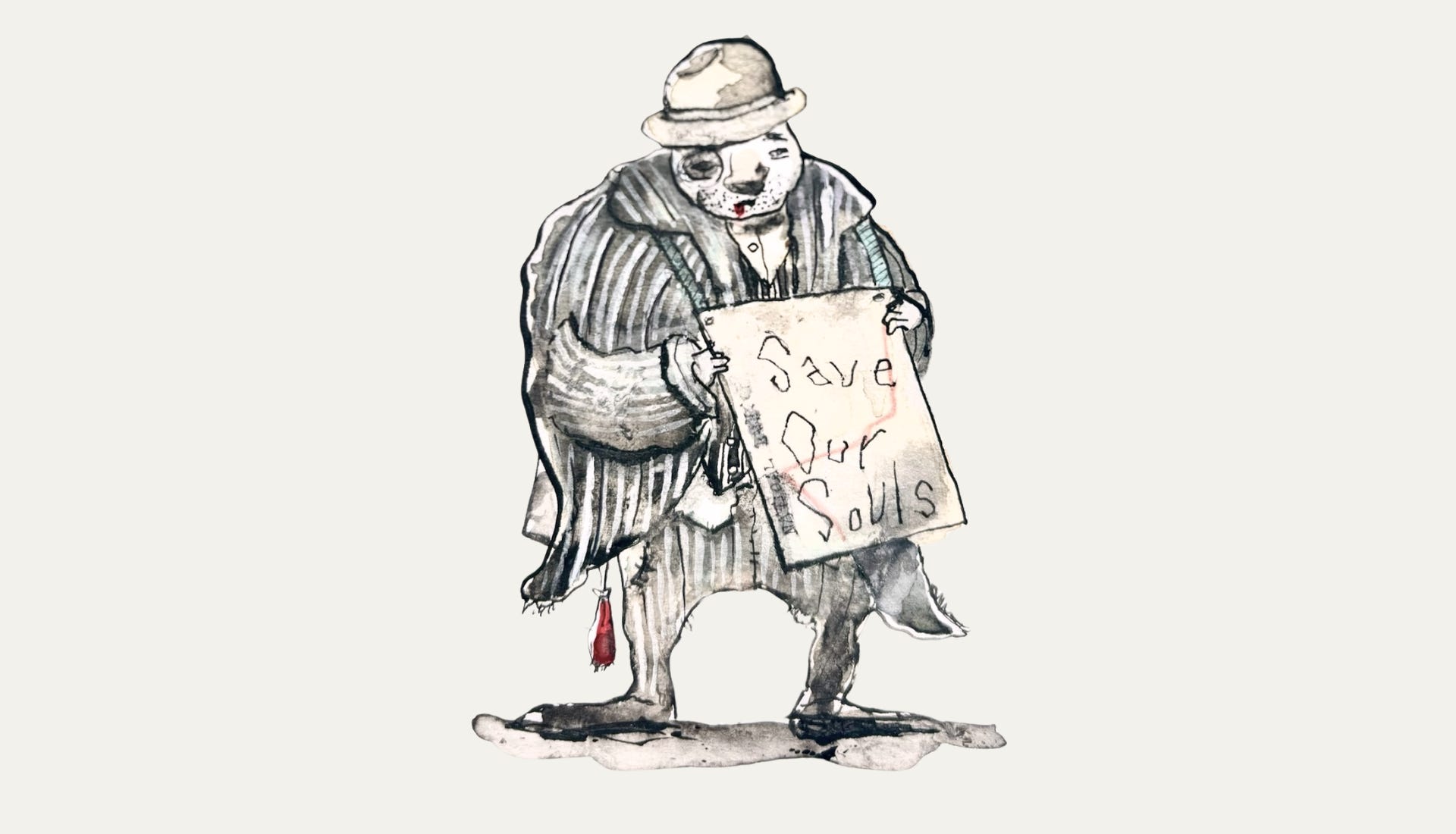
I don’t want to be dramatic (much) but when I tried to optimise and monetise my creative output beyond my natural capacity, it wrecked my creative expression for a long time. That led to burnout that took two years to recover from.
Here’s the part I find harder to admit because it feels icky. I chose that path out of greed. I wanted more money, more attention, more people clamouring for my time and the elusive feeling that people wanted “access to me”. I also wanted the thrill of limiting that access; to be so in demand as a creative that I could turn people away. I wanted a full inbox, a full calendar and the ability to join the tables where successful people swap tips on setting boundaries with the pesky general public. I wanted to be able to say “Pick my brain, huh? — Yes I have a £1,200 an hour service for that” and actually mean it. I wanted more.
There was a time when I got close, I was running a moderately successful creative business, I had a successful online shop, I was stocking Selfridges with my art, I’d been featured in Vogue, but I felt like something was missing. I wanted to be in demand in the way I imagined other artists to be in demand. I was hungry for popularity. In retrospect that probably dates back to my childhood.
In around 2019 began actively seeking out coaches and mentors who embodied this restless hunger. I’d hired them precisely to push me past my own hesitation. So when the work began feeling misaligned and stressful, and they kept pushing, they were doing exactly what I’d paid for. My ensuing anger at them was really anger at myself. The money oriented language “100k months” and “10x your revenue” wasn’t new either, and on some level I found it attractive. The gurus I sought out were towing that golden line, and towing it hard. When it started to feel nauseating, I was the one whose appetite had changed, but I didn’t have the courage yet to say so. What unfolded was a further two years of me guzzling from the generic business marketing trough until it felt suffocating, boring, frustrating, and worst of all… it felt like a Job with a capital J.
I wanted to feel like an artist, not an employee but I’d ignored that instinct for so long that I felt utterly trapped. There was financial pressure at play too: a growing family, a team, pressure to be the sole breadwinner. Worried that I wouldn’t be able to afford to keep paying for coaching, I started coaching emergent artists on how to get visible. I’d entered the pyramid to be able to afford the pyramid. The long Zoom calls, fancy mastermind retreats and endless talk of making a million were enticing. The dopamine hit of having my voice messages responded to by someone I admired was addictive.
In one of the more absurd moments in the story, I was embarrassed to tell the mastermind group I’d joined that I’d only made £370,000 that year because everyone else seemed to be talking about aiming for millions. In hindsight it’s clear to me that I was failing to celebrate what I had. Again, that was on me.
From a distance it’s easy to see that if there’s a nagging voice telling you to grab for more, it might be because you’re neglecting what’s already available to you. In my case it was my creative practice. Eventually the pedestals I’d foolishly built came down. I had to completely step away from self-improvement to finally improve my life and reconnect with my own creativity.
Even as I write this, my mind throws up a dozen caveats about my deep admiration for everyone who’s helped me on my way. A fear of being misunderstood and misconstrued isn’t the only reason for this; the admiration is real. They were genuinely good at helping business people, including me. I went from making about £1500 a month selling my art to running a membership with over 100 people in it, and coaching over 3000 artists in 4 years, all while having a second baby. But not one of my coaches had a creative practice. They excelled at running businesses that taught people how to run businesses— that isn’t the same as knowing what it takes to be an artist.
Looking back I did well, I have a lot of compassion for that version of me. I also remember being told time and time again that I wasn’t “going all in”. Every time I’d pushed back against the business advice I received, I’d been told it was “just resistance”— that I needed to love myself more, put more skin in the game and focus on growth, but here’s what I’ve learned since, and it’s something I now remind my small number of mentoring clients:
What if resistance isn’t a mindset issue you should fix? What if it’s an essential artist’s material guiding you towards alignment? What if that powerful resistance creates a kind of latent tension— like an archer pulling back an arrow, to be released with a potent force at the right moment? In other words: what if your resistance is useful?
I understand that not all arrows land where we want them to, but no coach, no mentor, no expert can know your alignment more deeply than you can. Mistaking your own deeper knowing for ‘bad resistance” is easy to do in a society that celebrates using force to mold the world around us. In her series of spoken word stories “The Power of The Crone”, Dr Clarissa Pinkola Estés tells stories of trees that can’t be tamed with ropes and brute force. No matter what the farmer does to hold down the branches, they break free towards the sun. “Don’t cast out your demons,” she cautions. “They might be the best part of you.”
I suspect that often your resistance is right. Your resistance is a primal warning, a sacred f*cking message, a portent that you ignore at your peril. Ignore it and pretty soon your body is yelling “f*ck around and find out!” The constant aches and pains, minor infections, hunched shoulders, headaches, all conspiring to get you to wake the f*ck up and trust yourself.
These days I listen to my resistance like it’s a sacred oracle, and encourage my mentees to do the same. That doesn’t mean I follow its instructions to the letter: resistance, intuition and fear are sometimes hard to tell apart. But if I stop and really listen, the way we listen to a piece of music we love, over and over, I start to decipher something else: the truth of things. When I take time to create without expectation, without a remit, for the art and the joy of it, I start to hear the beat of my own creative drum. Those beats lead me forwards. They led me directly to a place where I knew without hesitation that running a large scale coaching business was not for me. They led me to understand that my creative practices come first. My big missions like Creative Oxygen, a consultancy helping healthcare teams bring back creativity, are a result of that creative energy— not the other way around. I’ve also accepted that it’s ok for me to share my mentoring knowledge and experience with a small circle of people. I don’t have to scale to millions. I can do what I love by doing deep work with a small number of people. If that grows organically, then that’s wonderful, but I’m not going to destroy myself in the process.
I’m an artist and polymath, I need time and space. When it comes to my multitude of creative practices from drawing to painting, writing, sculpting and filmmaking, I can just make stuff and let it be. I can make art that never gets exhibited or published. I can write stories that only a handful of people read. I can hold an event for 7 people. I doesn’t mean I’ve failed.
I hope this helps you to trust your own creativity. When you don’t want to scale or monetise part of your creative expression, you aren’t always “in resistance because of fear”. Sometimes your soul just doesn’t want to turn something small and beautiful into something big and loud. Sometimes you are not ready to be observed. And that’s ok. When you have an instinct that you’re giving away too much creative energy to the wrong thing, you’re right. Pull back.
A truly magical thing happens when you start trusting your creative intelligence. If you beat your drum truthfully, your people will hear it, and if you’re consistent some of them will show up bearing gifts. Maybe not as many as you think you want right now, but give it time. Mostly that means gradually growing a relationship with paying and non-paying collaborators, people who are really, really listening.
If you’re an artist or creative visionary, take what you want from this. Knowing what you don’t want is just as important as knowing what you do want. Trust it.
Ways to Work With Me.
I work in three distinct ways, and they suit three very different people.
The Bold Work. 1:1 mentoring for established creatives who are ready to do their most uncompromising work yet. Book A Call
Creative Direction. For founders and practitioners who’ve outgrown their brand and need a creative photographic identity that meets them where they’re headed. See More.
Creative Oxygen™. For healthcare and tech organisations ready to treat creativity as the infrastructure it actually is. Learn More.
i’ve been thinking a lot about how writers share space on substack. it feels many still yearn for that superstar model — only subscribe to one yet cry that you’re not getting past 200 subscribers etc. feeling pressured to monetise that which demands slowness (slowness doesn’t fair well in this urgent efficient market we’re living in). this is a great piece, thank you 🙏🏾
Incredible confession and advice. I went through similar struggles. And perfect timing, I'm writing something on creativity and monetization and will probably quote from this article. Thank you.